


Today, the Intimate Reflections newsletter becomes Co·Awaken — not just a school, but a body of work, a teaching, a way of seeing. Welcome to what’s emerging, and read more to understand why.

A few days ago, I looked up the word technology.
I’d been resisting the word for years — at least in spiritual circles. When people spoke of “circle technology” for new ways of gathering people in circles during retreats, I felt the engineer in me roll his eyes. When my tea teacher, who coaches Silicon Valley execs, called tea a technology recently, something in me cringed. I thought, No, not you too.Technology meant science. Code. Systems. Things you could prove.
But the word kept returning. In a tea ceremony last week, I felt electricity move through my body when I held my awareness on two words: spiritual technology. My heart was beating fast. I didn’t know why it mattered. I just knew it did.
So I looked it up.
The root is Greek:
technē (τέχνη) = art, craft, skill, a way of making
logos (λόγος) = word, account, principle, reasoned explanation
Technology then was any systematic way of bringing something into being. Rhetoric was once a technology. So was blacksmithing. So was medicine. The word only narrowed during the Industrial Revolution, when we decided that only things related to science and industry deserved the name.
And in that narrowing, we forgot something essential.
The Recognition
I remember the first time I completely dissolved in a plant medicine. Somewhere in that dissolving, a thought arose: This is very advanced alien technology.
Something extremely mystical and important was happening — and present-day science had no way of explaining or proving it. Yet it was undeniably real. Undeniably working on me in ways I couldn’t explain.
There are systems for transformation that have been refined over thousands of years. Plant medicines. Breathwork. Tantric practice. Chinese medicine. They work — not because we can prove them in randomized controlled trials, but because lineages have tested them on countless human bodies and passed down what reliably opens, heals, and awakens.
Over Christmas, I talked with my dad about his work. He runs the oldest Chinese herb store in California. He helped create the San Francisco campus for the top Chinese medicine university in China — a four-year program that conferred bachelor’s degrees to nearly fifty adult students.
Chinese herbs have thousands of years of clinical history. In China, Chinese medicine is woven into the mainstream medical system — hospitals, universities, clinical training. Most of it wouldn’t fit the FDA drug-approval pathway in the United States as it exists today. Not because it doesn’t work — because it doesn’t fit certain modern-day, Western beliefs about what medicine has to be. It doesn’t fit the boxes.

And I realized: I’ve been holding a similar kind of judgment toward what I’ve learned on the spiritual path.
Underneath was a belief I didn’t even know I was carrying: If it’s not proven by science, it’s not really technology. It’s woo. It’s alternative. It’s belief.
The other day, I listened to a friend share about a relational rupture with his partner — something he couldn’t find his way through. And I could see the mechanics. The physics of the situation. The way through.
I shared what I saw, but not with my full spine.
Even though some part of me knew how rupture works, I softened it. I hedged. I spoke from somewhere smaller than my actual knowing.
If I were in an engineering context, describing how a system worked, I wouldn’t apologize. I wouldn’t shrink to avoid seeming arrogant. I wouldn’t say “this is just my experience.”
I would say: this is how it works — while remaining open to revision if reality proves otherwise.
I’ve lived inside the mechanics of desire, attachment, projection, rupture and repair — intimately, painfully, devotionally — for seven years. My authority doesn’t come from theory. It comes from repeated contact with laws of relational reality.
And my humility in shrinking that knowing doesn’t serve anyone.
This phrase — spiritual technology — is an invitation. To fully claim what I’ve learned. To share with the same spine I would bring to any domain where I’ve earned my knowing. To stop treating the relational and the sacred as somehow less rigorous, less mappable, less real.
There’s a fidelity to how things actually work. And I’m ready to speak from the recognition.
The Claim
What I’m claiming is radical:
There are reliable, lawful, repeatable dynamics by which human beings come into contact with truth, love, attachment, power, and awakening — and they are embedded in partnership and sex.
Awakening has mechanics — alive mechanics.
Just like breath has mechanics. Just like attachment has mechanics. Just like desire has mechanics. Just like rupture and repair have mechanics.
Most spiritual spaces say: This works… sometimes… if you’re open… if the energy is right.
Spiritual technology says: When we put human nervous systems into certain configurations, truth appears.
Life itself is already a perfectly functioning spiritual technology — and partnership and sex are among its most precise interfaces.
I’ve been sitting with Simon Sinek’s Golden Circle lately — the what, the how, the why. His thesis is that the most inspiring leaders and movements start from the inside out: they lead with why they do what they do, not what they do.
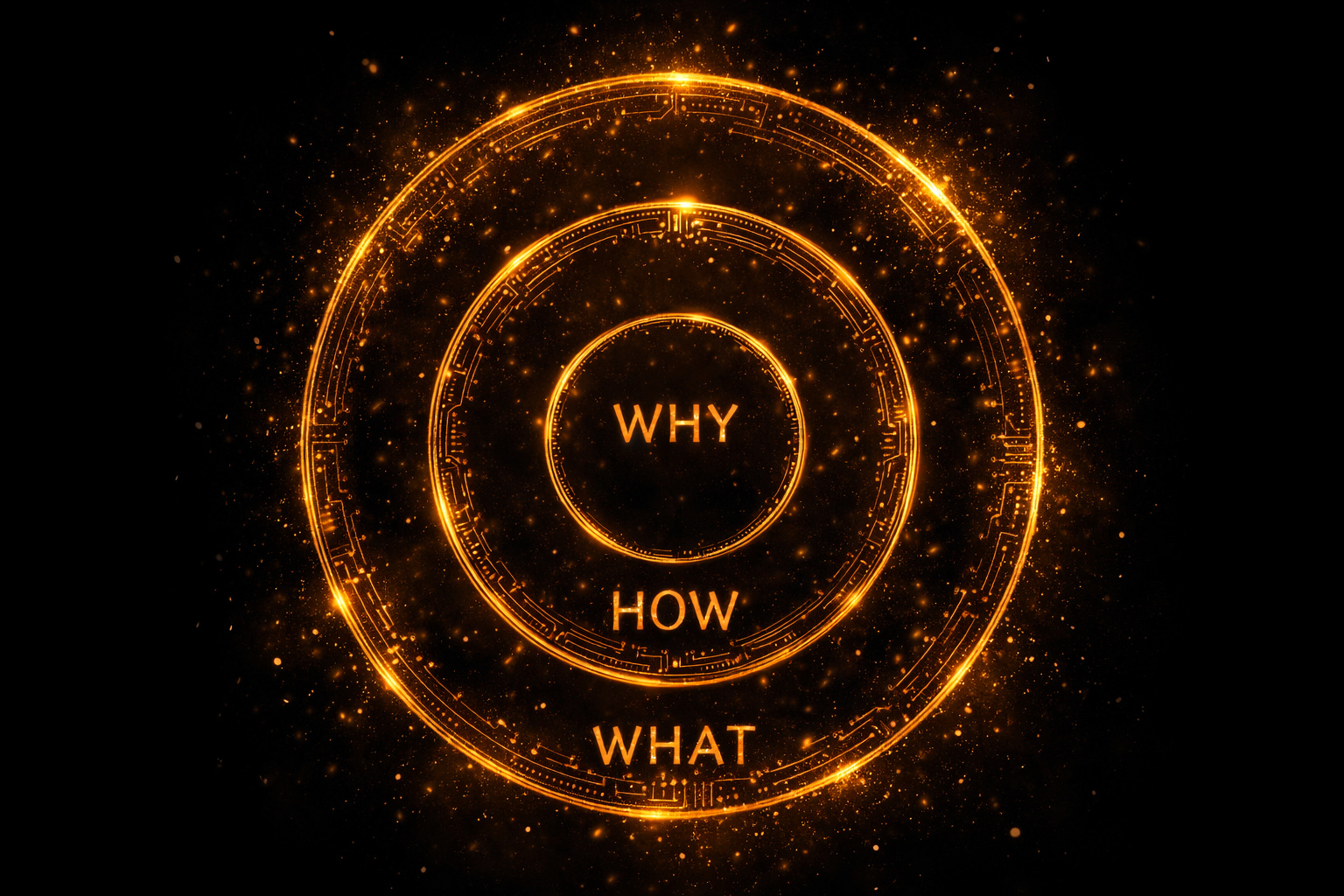
At the end of last year, I realized the school was the what. Co·Awaken is emerging to be a school of awakened relating through the path of partnership.
But what is the why?
The Golden Circle helped me see something I hadn’t fully articulated about Co·Awaken:
We believe partnership and sex are high-leverage spiritual technology — the most embedded and direct path to awakening, woven into our daily lives. When partnership transforms, everything transforms: our homes, our families, our work, our communities.
I know this because I lived it.
For seventeen years, I circled around sex in shame and silence. When that chapter ended, I didn’t just want intimacy — I wanted to understand it. Not just as a concept but as a lived experience.
And through years of practice, rupture, healing, and devotion with my partner Kiki Candace Sauve, I now live something I couldn’t have imagined.
Deep love of life. Deep love of each other. Deep secure attachment — not just to one another, but to reality itself, to desire itself. A sense of awakening together. A sense that anything is possible.
We just created our vision boards for 2026. And there’s a knowing — not hope, knowing — that what we envision will become true. A deep trust that we’ve cultivated through years of showing up for what’s hard.
Not because I figured it out. Because I let myself be transformed.
If a man like me — with generations of conditioning and seventeen years of shutdown — can create a life this beautiful and nourishing and alive, then so can anyone.
The Form
For the past four and a half years, I’ve been writing this newsletter under the name Intimate Reflections. Some part of me always knew it was a temporary container — a cocoon where I could discover what wanted to emerge.
What emerged was Co·Awaken.
And now the cocoon has done its work.
Starting today, this publication carries the name — Co·Awaken — of what it’s becoming. A school that runs in my lineage, a thing I’m in devotion to, a thing I want to last beyond me.
This year, I’m building a pilot program — a four-to-seven day immersive container for couples. Partnership and sexuality and attachment woven together. The practices that transformed my own life, distilled into something others can live.
There’s much I don’t yet know. But I do know the essence:
Technology, at its root, is the craft of bringing something into form.
I am bringing a school into form.
If you’ve been reading along, thank you. The experiment continues — now with a name that matches what it’s becoming.
If you’re new here, welcome. You’re witnessing a school being built in real time.