


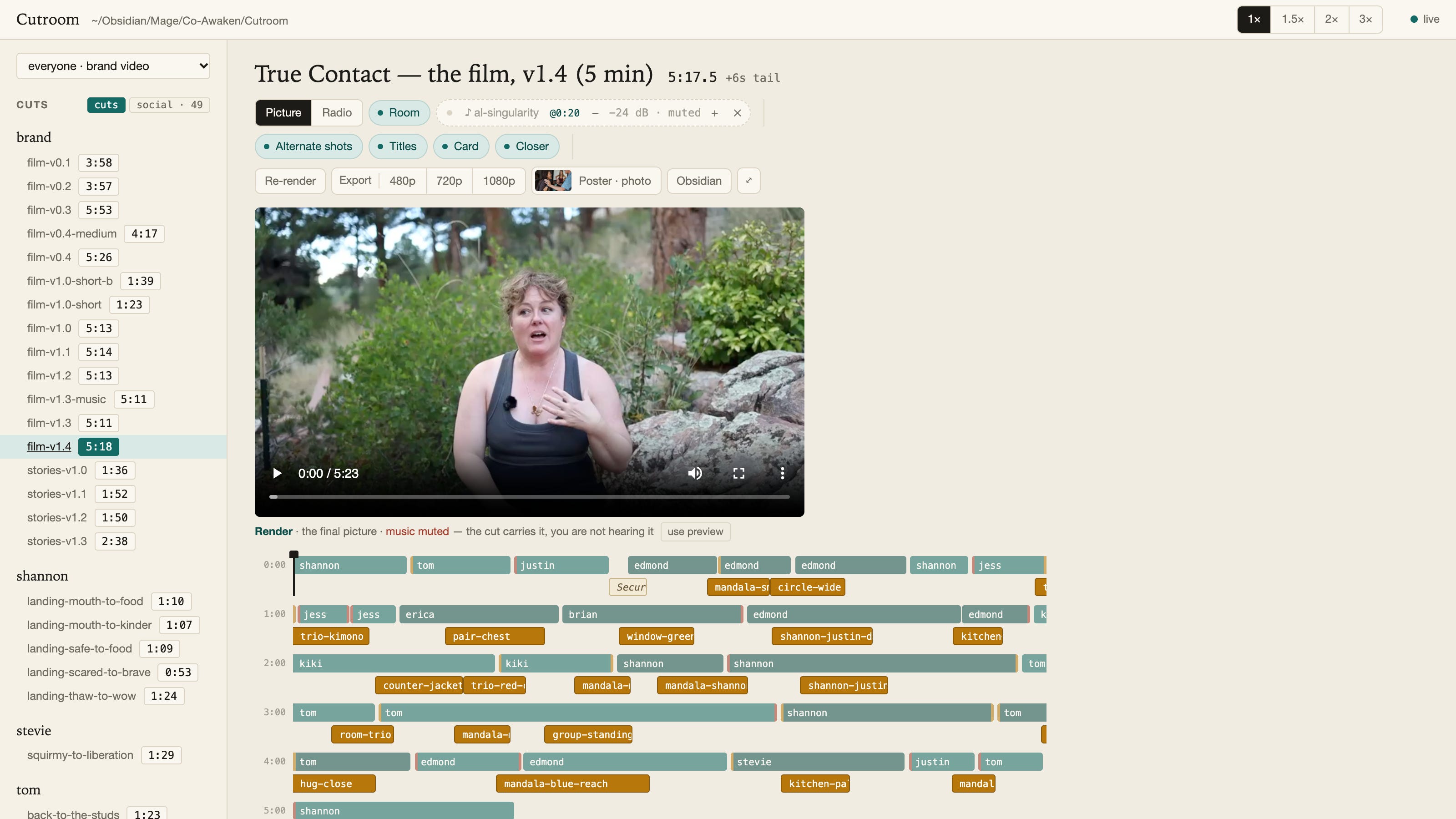
I pasted a sentence from one person’s transcript next to a sentence from another’s and saved the file in my text editor. In my prototype tool, I watched the footage of each of them speaking those exact words cut together, one after the other, in real time.
This was how I was going to make the film.
Last week I shared it: a five-minute film on True Contact, the embodied dyad practice we teach for meeting what’s beneath the surface and creating secure attachment with Life.
This is the behind-the-scenes story of how it came into being, and what I learned about trusting that I can bring into the world the thing I want to exist.
I’d worked very little with video and didn’t know what it would take to make something polished. One counterintuitive lesson from my startup days: it’s often more effective to build your own tool than to wrestle with an off-the-shelf one. I knew, after looking into what’s out there, that building my own software was the fastest (and most enjoyable) way to bring this vision into form.
What stayed with me most was the simple, powerful act of having a creative vision and bringing it into reality. Since starting my journey of building a modern-day school for awakened relating, I’ve been both learning and teaching secure attachment with Life: the trust that we are held, no matter what. Making this film initiated me into a deeper layer of that trust.
And the way I made the film is the backstory of how Co-Awaken itself is being built: engineering woven into the creative work at every level, used to meet, with increasing precision, what is true and what is needed.
From Idea to Form
The film started months earlier, before the founding True Contact cohort even began, with an inspired idea: bring my friend Violet in to record the last session. For this work to spread, we needed people’s stories, and footage of the practice itself. Booking her before the cohort began meant trusting that by the last session, there would be stories worth recording.
I had no way to turn that footage into a story. I knew from producing previous courses how much effort editing media can take. And yet there wasn’t a moment in the making of the film that I thought, “I can’t do this.” I trusted I could make it.
The first key step: I needed a fast way to experiment with different video cuts.
When I wrote The Effective Engineer, a principle in one of the chapters was to “invest in iteration speed.” It’s baked into my DNA by now, but this is the most deeply I’ve felt it move through a creative, personal vision.
That speed mattered because I wanted to stay in intimate contact with the story while I was shaping it. Every minute spent searching for clips was a minute out of contact with the inspiration that wanted to move through me. Slow tools make contact harder.
I wanted tools that fit the way I work, and I’m grateful to live in an age of AI where I could build exactly that.
Every limitation of someone else’s software that I couldn’t work around, everything I’d have needed to look up, would have taken away the life force in me that wanted to pour into the film. So alongside making the film, I incrementally built the tools to make it.
Editing with Words
I know that I’m a powerful storyteller. And the founding cohort of True Contact had given me beautiful raw material. Just listening to the testimonials end to end, I’d feel awe, and sometimes tears, at the beauty of what we’d created. I wanted to work with people’s words: find the sentences that moved me, put them next to each other, and feel what happened.
So I had AI transcribe every video, and built a system where I could copy and paste text verbatim from different transcripts and have it assemble the video for me. Editors call this a “paper edit,” arranging the story in text before you touch the footage. Mine went one step further: changing the text changed the cut.
I started calling the tool I was building the Cutroom. Paper edits got cheap enough that I could iterate on dozens of cuts in an hour, each one just a different arrangement of sentences, and AI could propose a cut of its own in under a minute. Different lengths, different story arcs. Then I’d watch each one and feel in my body how much it resonated, and where it didn’t.
The film opens with three faces. Shannon: I’m getting to work on the most challenging parts that I have hidden for my whole fifty years of life. Tom: This is the first thing that has felt like a shortcut to go right to the heart of the matter. Justin: What I got to learn here is how to feel met by the world, by the universe.
Three separate interviews. I pasted the sentences one under the other, saved, and watched it play. When it played, I felt the excitement of a film already telling itself.
I also wanted to see people doing the dyad practice we teach while their voices told their stories. So I had AI watch every clip, note the faces it saw, and write a short description of what was happening, and Cutroom could lay that B-roll over the interviews on its own.
I also wanted text on screen, so Cutroom layers it over the video as HTML. I worked as close to the metal as I could, in text and HTML, because that’s what AI edits fastest.
Building Cutroom on the fly, while I was editing, felt like reaching into the ether and materializing exactly the custom-shaped tool I needed to unfold the next part of the film. It was an exercise in trusting Life: reaching for something before it existed, like Indiana Jones stepping onto the invisible bridge in The Last Crusade. Each tool appeared as I needed it, one step at a time.
The first time I showed an early cut to Kiki and her family, I was nervous. Part of me wanted to explain it first. I decided to just show them. Contact and feedback were how I’d move forward, and part of secure attachment to my own expression was letting the work be seen before it was done, naked in my excitement.
All of Me
Then came all the little things I hadn’t known I’d need to learn.
We’d recorded the testimonials outside because the space had nowhere else to put us. Cars went by. The light went too, and by the last interview it was nearly dark. So I learned how much quality audio matters, how to remove background noise, and how to lay a “room bed” of continuous ambient sound under the edits so the background stops jumping between them.
Some edits clipped a word off too abruptly, and after trying to fix that automatically I built little tools to adjust exactly how much audio was allowed on either side of a cut.
Then there was music. I was 95% done, and finding a track felt daunting. I almost left it out. The question looked like “do I add music or not?” but underneath it I met a place in myself that was almost done and simply afraid.
Afraid to trust my own ear: picking music, even for the Sacred Edge, has often felt vulnerable and scary. Afraid of choosing something that would pull attention away from the story. I chose to be with the fear rather than manage it. Then I built tools to search for licensable tracks and set their volume so the music sat under the voices without taking them over.
By the end, the harness mattered to me as much as the film.
It felt beautiful how much of my full self got to participate. The engineer, bringing years of technical mastery to Cutroom, the same engineering that runs behind the scenes of the school’s operations, now building a story instead of a dashboard. The storyteller, finding the sentences that moved me and placing them next to each other. And the creator, the life force moving through me and pouring into something I wanted to exist. All three woven into one coherent expression.
What’s left in me is a deeper secure attachment with my own creatorship. Each time I followed the vision, changed the words, and watched the film take shape, the trust that I can bring what I want into the world became more tangible.
And Cutroom isn’t done. We’re launching Co-Awaken’s social media now (follow us at @coawaken), and the same footage will soon become something else: different cuts, different lengths, different shapes.
Months ago I knew that for this work to spread, we needed people’s stories. Now I have a place to keep telling them in.
The film, and the stories behind it, live at coawaken.com/true-contact/film.
—-
This publication is my personal stories from the living edge of building the school. The school itself has its own newsletter, Letters from Co-Awaken: what we are learning as we build it, and the teachings of secure attachment behind the film.